 THE GLOBAL WINDOW OF TURKISH FOOD AND AGRICULTURE The Global Window of Turkish Food and Agriculture Sector


Related Articles
June, 2026…
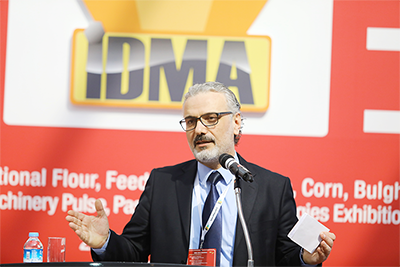
Professor Dr Mustafa Bayram, Dean of the Faculty of Engineering at Gaziantep University and Chair of the Association for Grain and Pulses Processing Technologies, Storage and Analysis Systems (TABADER) Board of Directors, stated in his address at the IDMA Global Grain & Milling Forum that the new competitive edge in the milling industry would be determined not so much by factory capacity as by the ability to process data. Emphasising that businesses unable to fully embrace Industry 4.0 will struggle in the Industry 5.0 era, Dr. Bayram noted that artificial intelligence, carbon footprint, energy efficiency and a skilled workforce have become critical issues for the sector.
Professor Dr Mustafa Bayram assessed the digital transformation process in the milling sector during the session titled ‘Industry 4.0 in Milling: Smart, Sustainable and Scalable’ at the IDMA Global Grain & Milling Forum held last week in Istanbul. In his speech, Bayram highlighted the unique place of milling within industrial history, noting that mills are one of the oldest technological systems in human history. Defining milling as “Industry 0.0”, he emphasised that the sector is one of the most deeply rooted fields not only in the history of food production but also in the history of industrial and manufacturing technologies.
According to Dr. Bayram, Industry 4.0 is no longer merely a vision for the future, but a framework that has, to a significant extent, been put into practice. Technologies such as 3D printers, the Internet of Things, smart factories, cyber-physical systems, big data, robotics, simulation, system integration, cloud systems and augmented reality have now become an integral part of industrial production. However, Dr. Bayram pointed out that when Industry 4.0 was first conceived, artificial intelligence did not occupy as central a position as it does today. Noting that artificial intelligence has penetrated both everyday life and industry at a rapid pace over the last few years, Dr. Bayram stated that this technology would be one of the key drivers of Industry 5.0.
Dr. Bayram described Industry 4.0 using the metaphor of a ‘major digital motorway’. He explained that, thanks to big data, the Internet of Things, system integration and automation, industry has established a very robust main highway; however, he underlined that alternative solutions have not yet been sufficiently developed to cope with a breakdown or disruption on this highway. In his view, Industry 5.0 will bring to the fore systems that are more flexible, more resilient and capable of creating ‘side roads’ when necessary…