 THE GLOBAL WINDOW OF TURKISH FOOD AND AGRICULTURE The Global Window of Turkish Food and Agriculture Sector


Related Articles


30 June, 2026…
Türkiye’s potential to become a regional grain storage and trading hub came into focus at the IDMA Global Grain & Milling Forum. Speakers pointed to the country’s expanding licensed warehousing capacity, the development of the Turkish Mercantile Exchange, plans to trade bonded warehouse products in foreign currencies, futures contracts for price risk management and the need for stronger logistics resilience in global grain markets.
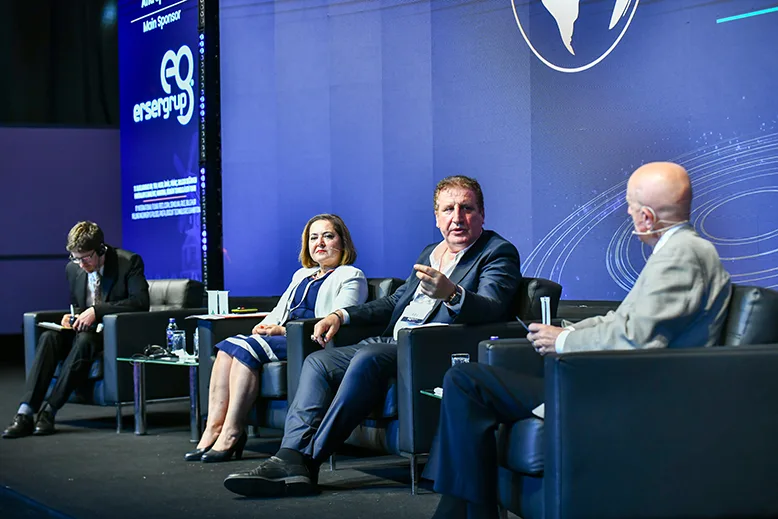
Türkiye is strengthening its role in grain trade through storage, logistics and market infrastructure, not only through production and processing. This was one of the main themes of the “Innovations in Grain Storage, Handling and Logistics” session at the IDMA Global Grain & Milling Forum in Istanbul, where speakers discussed Türkiye’s potential to become a regional grain storage and trading hub. The session was moderated by İsmail Uğural, Chairman of the Turkish Association of Agricultural Journalists and Writers. Speakers included Jonathan Hepburn, Counsellor at the World Trade Organization, Assoc. Prof. Necla İ. Küçükçolak, Executive Vice President of the Turkish Mercantile Exchange (TMEX) and Serdar Genç, Chairman of LİDAŞDER, Türkiye’s Association of Licensed Warehouse Companies.
The session showed that storage and logistics are becoming strategic for the grain sector. For Türkiye, this is closely linked to its ambition to serve not only its domestic market, but also nearby regions that depend on reliable grain flows, including the Middle East, North Africa and other import-dependent markets.
Serdar Genç said licensed warehousing has become one of the most important structural developments in Türkiye’s agricultural commodity markets. He described licensed warehouses as Türkiye’s “grain dams”, a metaphor that reflects their role in balancing supply after harvest, protecting product quality and supporting the functioning of the market.
In Türkiye, harvest is concentrated in a relatively short period. Without reliable storage, farmers may be forced to sell quickly, while industrial users may have difficulty accessing the right product at the right time. Licensed warehouses help reduce this pressure by allowing grain to be stored safely, classified properly and traded through electronic warehouse receipts.
Genç said Türkiye’s licensed warehouse capacity has reached around 14.5 million tonnes. According to him, this covers nearly 80 percent of the country’s current need. He also said Türkiye could reach around 17 million tonnes of required licensed warehouse capacity in the near term.
FROM DOMESTIC STORAGE TO REGIONAL GRAIN TRADE
Genç emphasized that licensed warehousing should not be viewed only as a domestic market tool. Türkiye’s geographic position, port infrastructure and expanding storage capacity give the country an opportunity to strengthen its role as a regional grain storage and trading hub. He said licensed warehouses are largely located in production areas where Turkish farmers can use them, but port-side bonded warehouses should also be considered as part of a broader system. If bonded warehouses at ports are integrated into a controlled and transparent structure, Türkiye could provide a stronger platform for regional grain trade.

This point is especially relevant for buyers and sellers in nearby regions. For markets in the Middle East, North Africa and other import-dependent areas, Türkiye’s storage, port and trading infrastructure could offer new channels for access, delivery and redistribution.
Genç also underlined the importance of trust. He said isolated problems in the system should not damage confidence in the entire licensed warehousing model. Stronger supervision, better control mechanisms and remote monitoring are needed to protect the credibility of the system.
TMEX IS BUILDING A MORE TRANSPARENT COMMODITY MARKET
Assoc. Prof. Necla İ. Küçükçolak gave a detailed overview of the Turkish Mercantile Exchange, known as TÜRİB in Türkiye, and its role in the agricultural commodity ecosystem. She said TMEX was established in 2018 and became operational in 2019. Its main function is to operate spot and futures markets for agricultural commodities. Küçükçolak explained that Türkiye’s system brings together licensed warehousing, authorized classification, trade exchanges, intermediary institutions and electronic warehouse receipts under an integrated structure supervised by the Ministry of Trade.
According to the figures she shared, Türkiye currently has 268 licensed warehouse companies operating in more than 350 locations. Agricultural products delivered to these warehouses are classified according to standards determined by the Ministry of Trade and Turkish Standards Institution. Once standardized, they can be traded as electronic warehouse receipts. This standardization is the key condition that allows agricultural commodities to become tradable in an organized market.
Küçükçolak said standards have been published for 20 agricultural products, and 17 of these have already been traded on TMEX. However, she noted that TMEX is still mainly a grain exchange. Wheat has the largest share in trading volume, followed by corn and barley. She also said TMEX’s transaction volume has exceeded 18 billion dollars since its establishment.
For the grain sector, this is significant because organized spot markets help create transparent and referenceable prices. Küçükçolak emphasized that the rules of the exchange apply equally to all market participants, making the prices formed on TMEX useful as reference prices for the sector.
BONDED WAREHOUSE TRADING COULD SUPPORT TÜRKIYE’S REGIONAL HUB ROLE
One of the most important projects discussed by Küçükçolak was the planned trading of products stored in bonded warehouses. She said imported products held in bonded warehouses will be able to trade on TMEX in foreign currencies such as U.S. dollars and euros once final regulatory approval is completed. This is a strategic development for Türkiye’s regional grain hub potential.
Under the planned system, owners of products stored in bonded warehouses will be able to apply for quotation on TMEX. Buyers based in Türkiye or abroad will then be able to purchase these products through the exchange. Since the transactions will be carried out in foreign currency, an integrated payment and delivery structure is being developed with Ziraat Bank. Küçükçolak said this mechanism could allow buyers from regions such as Africa and the Middle East to access products stored in Türkiye through a more transparent and organized market structure.

This project could help Türkiye connect its port-side warehousing capacity with international commodity trade. It would also add a new layer to the country’s role as a regional logistics and trading platform.
FUTURES CONTRACTS COULD BE THE NEXT MAJOR STEP FOR TÜRKIYE’S GRAIN MARKETS
Küçükçolak also pointed to futures contracts as one of TMEX’s next major priorities. She said TMEX is working on futures instruments for wheat and corn, with possible future products such as barley or index-based contracts. The purpose is to support forward-looking price formation and help the sector manage price risk more effectively.
At the initial stage, TMEX plans to start with a limited number of maturities so that liquidity is not fragmented in a developing market. Küçükçolak said harvest-period contracts are especially important, such as July for wheat and September for corn. Year-end and March contracts are also being considered.
This development is important for farmers, traders, millers and industrial users. Spot markets show today’s price. Futures markets help manage tomorrow’s risk. For Türkiye’s grain sector, futures contracts could provide better hedging opportunities, more predictable pricing and a more mature market structure.
DIGITAL SUPERVISION AND EARLY WARNING SYSTEMS
Another major theme in Küçükçolak’s remarks was digital supervision. She said the Ministry of Trade has assigned TMEX a role in the supervision of licensed warehouses and the development of technology-based remote monitoring systems. The aim is to use sensors, data flows and early warning mechanisms to monitor licensed warehouse operations more effectively. The planned system will help monitor warehouse movements, product entries and exits, electronic warehouse receipt issuance and cancellation processes, truck movements and other risk indicators.
INNOVATION MUST BE SUPPORTED BY PREDICTABLE TRADE RULES
Jonathan Hepburn brought a global trade perspective to the session. He said innovation in grain storage, handling and logistics can improve productivity, competitiveness and resilience. But he also emphasized that innovation alone is not enough. Markets also need predictable rules, transparency and international cooperation.
Hepburn noted that the grain and oilseed sectors have faced several major shocks in recent years, including the COVID-19 pandemic, the war in Ukraine, attacks in the Red Sea, tensions around the Strait of Hormuz, climate-related disruptions, trade tensions, tariff increases and export restrictions. For import-dependent countries, these disruptions are not only logistics problems. They can affect freight, access, prices, timing and food security.
Despite these shocks, Hepburn said global food and agricultural trade has shown remarkable resilience. He noted that, since the beginning of the century, the value of food and agricultural trade has grown roughly five-fold, despite major disruptions such as the 2008 financial crisis, COVID-19 and the war in Ukraine.
He also pointed out that around 72% of global goods trade still takes place on core WTO terms. For Hepburn, this is an important reminder that the rules-based trading system continues to provide stability and predictability, even at a time of geopolitical tension.
GLOBAL GRAIN RESILIENCE DEPENDS ON MORE THAN INFRASTRUCTURE
Hepburn said the WTO contributes to the functioning of global markets through several channels: implementing existing agreements, negotiating new rules, providing a forum for dispute settlement, building the capacity of developing countries and working in partnership with other international organizations.
He referred to agreements such as the Agreement on Agriculture, the Sanitary and Phytosanitary Measures Agreement, the Trade Facilitation Agreement and rules related to intellectual property. He also highlighted the role of trade facilitation in reducing red tape at borders and easing the flow of agricultural trade.
Hepburn also underlined the importance of digital tools such as e-phyto certificates, which help facilitate safe trade in food and agricultural products. He mentioned the Standards and Trade Development Facility as a partnership that supports developing countries in meeting food safety and trade standards.
Another key initiative he highlighted was AMIS, the Agricultural Market Information System, which was established by the G20 after the 2011 food price spikes to improve transparency in global agricultural markets. For Hepburn, transparent market information is critical for reducing uncertainty and supporting food security outcomes…
Source: Miller Magazine