 THE GLOBAL WINDOW OF TURKISH FOOD AND AGRICULTURE The Global Window of Turkish Food and Agriculture Sector



Related Articles



July, 2026…
The Black Sea grain market has been thrown into turmoil after Russia and Ukraine sharply intensified their attacks over the past week, targeting ports, export infrastructure and commercial shipping, and disrupting grain exports across the region at the peak of the harvest season.
ATTACKS IN THE AZOV SEA PUT RUSSIAN GRAIN LOGISTICS UNDER PRESSURE…
Since July 7, 2026, Ukrainian forces have reportedly targeted tanker vessels in the Sea of Azov with drones, while bulk carriers were also reported to have been affected in the following days. Reports covering the period from July 7 to July 12 indicated that as many as 116 vessels may have been affected.
The attacks prompted Russian authorities to close the Azov–Don Canal and the Kerch Strait, according to market rumours that emerged on Friday. Although no official announcement confirming the closures was issued, vessels were reportedly prevented from entering the Sea of Azov from the Black Sea. According to local sources, vessels already in port were permitted to complete cargo discharge operations but were not allowed to leave port and enter the sea.
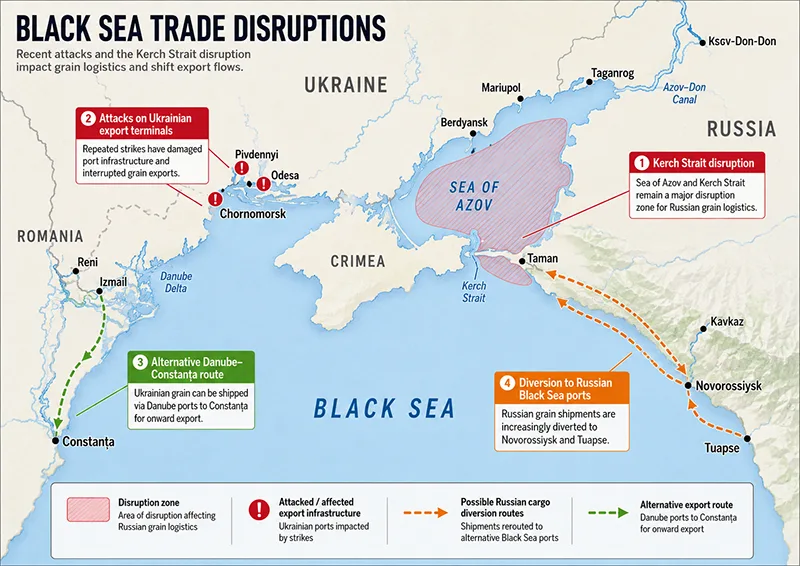
The shallow-water ports of the Sea of Azov account for around 19% of Russia’s wheat exports, with annual shipments estimated at nearly 9 million tonnes, equivalent to approximately 700,000 tonnes per month.
However, export activity through the Sea of Azov has been subdued in recent months, as Türkiye, the main destination for wheat shipped from the region’s ports, has remained largely absent from the market. Turkish buyers have been slow to make purchases amid expectations of a record domestic wheat crop and earlier speculation that the country could introduce a wheat import ban, both of which have weighed on demand.
As a result, market participants said the immediate impact of the Azov port closures on export volumes was likely to remain limited. However, a prolonged disruption could have broader implications for Russian grain logistics if vessels are forced to shift to alternative Black Sea ports.
The closure of the Kerch Strait could also disrupt operations at the deep-sea ports of Kavkaz and Taman, which are located immediately beyond the strait. Trade sources said that if the strait remained closed for a prolonged period, traders that had already booked shipments from these ports might attempt to switch to other Black Sea ports, such as Novorossiysk or Tuapse. Such a shift could further complicate inland deliveries, which have already been affected by fuel shortages and rising diesel and gasoline prices.
The escalation has pushed global wheat prices higher, particularly prices for milling wheat, as Russia is the world’s largest exporter of milling-quality wheat. Offers for Russian wheat with 12.5% protein rose by around $10 per tonne between July 9 and July 15, reaching approximately $240 per tonne.
DIRECT ATTACKS ON PORTS AND VESSELS DISRUPT UKRAINIAN GRAIN EXPORTS…
Meanwhile, in Ukraine, Black Sea ports, grain and vegetable oil terminals, and grain-carrying vessels came under heavy Russian missile and drone attacks between July 10 and July 14. Ukraine’s largest agricultural products exporter, Kernel (Inerco), announced the suspension of its operations following the extensive attacks on the Port of Chornomorsk. The company reported damage to terminal equipment, power lines and grain storage facilities. Around 45,000 tonnes of wheat and 9,000 tonnes of sunflower oil were also reported to have been affected. A subsequent attack on the vegetable oil terminal damaged around half of the company’s oil storage facilities at the terminal and affected a further 25,000 tonnes of sunflower oil.
In addition to Kernel, several other grain and vegetable oil terminals were also reported to have been affected, although the companies concerned did not issue public statements. Vessels were also affected alongside ports and terminals, with casualties, including fatalities, reported among crew members.
These developments have led shipowners to refuse to call at Ukrainian deep-sea ports. “For as long as the attacks continue, there is little chance that shipowners will be willing to call at the affected ports, including those that had continued operating there until now despite the attractive risk premium. As a result, exports are likely to remain on hold for the time being,” a market source said.
Several freight market sources said the key difference between the current situation and earlier attacks on Ukrainian ports was that vessels were now being directly targeted and crew members had suffered significant casualties.
During previous periods of sustained attacks, crew casualties, particularly fatalities, were relatively rare. As a result, shipowners were generally still willing to accept the risks associated with calling at ports in the region.
Although the outlook remains unclear, market participants suggested that traders could once again turn their attention to transit routes through the Danube ports and onward to the Port of Constanța, as they did between 2022 and 2024.
FREIGHT RISKS PUSH WHEAT PRICES HIGHER…
In terms of prices, high uncertainty over shipment possibilities and expectations that freight rates would rise sharply, even if vessels remained willing to call for loading, kept Ukrainian FOB prices broadly unchanged from the previous week. Ukrainian wheat with 11.5% protein was assessed at $229–230 per tonne FOB. In the domestic market, however, most major trading companies, including the ABCD firms, stopped indicating purchasing prices on July 15.
Meanwhile, Euronext wheat futures moved further higher on July 15 following the escalation. The September wheat contract rose by €15 per tonne to €231.50 per tonne, while the December contract increased by €11.75 per tonne to €234.50 per tonne.
Against this backdrop, Romanian wheat with 12.5% protein, along with Bulgarian wheat, was considered one of the few relatively low-risk origins in the Black Sea region. On July 15, Romanian wheat was heard offered at around $260 per tonne on an FOB Constanța-equivalent basis, approximately $20 per tonne above Russian wheat with the same protein content.
The disruption comes at a particularly sensitive time for the Black Sea market, as the wheat harvest is currently underway. Trading activity had already been relatively subdued in recent weeks, and even months, with many buyers holding back in anticipation of further price declines. Market participants were also reluctant to book July shipments following last year’s experience, when many traders were forced to cover short positions at a loss. Although some business had been concluded for August shipment, activity remained limited. Those contracts are now coming under increased scrutiny as market participants assess the potential impact of the disruptions on export logistics.

By Masha Belikova,
Senior Grain Market Analyst
Source: millermagazine.com