 THE GLOBAL WINDOW OF TURKISH FOOD AND AGRICULTURE The Global Window of Turkish Food and Agriculture Sector


Related Articles


August 2026…
Turkish Mercantile Exchange (TMEX – TÜRİB) General Manager Ali Kırali announced that since TÜRİB’s launch, the trading volume in the Electronic Warehouse Receipt (EWR – ELÜS) market has reached 475 million Turkish Lira and the transaction quantity has reached 64.5 million tonnes. “In addition to our national market, we have completed the software for a new International Commodity Market Project to enable trading of products in bonded warehouses (Entrepots) under the control of the Ministry of Trade in our country’s ports. We will launch this market within 1-2 months,” Kırali said.
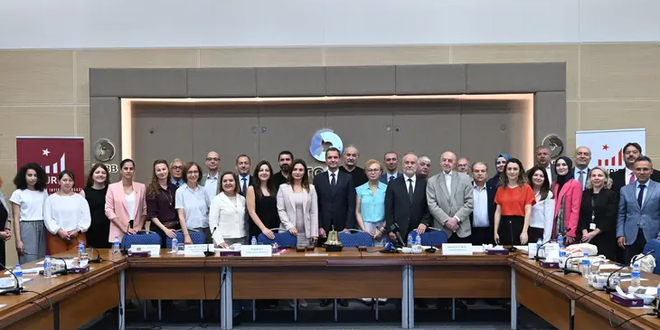
A press meeting was held by the Turkish Guild of Agricultural Journalists (TAGYAD) to mark the 7th anniversary of the launch of the Turkish Commodity Exchange (TÜRİB) and the 2026 International Year of Women Farmers.
“Managing abundance is also important”
Speaking at the event, Professor Dr. Aykut Gül, a member of the Presidential Board of Agriculture and Food Policies, said that managing the expected abundance in plant production this year, following last year’s shortage, is another challenge.
Underlining the difficulties in food supply due to congestion in global logistics corridors, Dr. Gül said, “If you cannot deliver what you produce to the market for those who need it, there is a major problem. While all major states in the world are closing roads, we, as Türkiye, are opening them. New corridors, primarily the Development Road, the Middle Corridor and most recently the Hejaz Railway… When you look at all of these, Türkiye is becoming a central country that significantly increases its visibility. This is very valuable.”
Indicating that it is impossible to achieve certain things without understanding the markets, Dr. Gül stated, “TÜRİB plays a significant role in regulating the market, since the production cannot be done all year round, therefore the system is important in terms of storing products and protecting both producers and consumers.”
Licensed warehouse capacity approaches 15.2 million tonnes…
TÜRİB General Manager Ali Kırali explained that looking at the average of the last 5 years, Türkiye has an annual grain harvest of around 37 million tonnes, and that approximately 41 percent of this has been reached in terms of storage capacity.
Pointing out that the licensed warehouse capacity, which was 4 million tonnes when it was established in 2019, has approached 15.2 million tonnes in 7 years, Kırali continued:
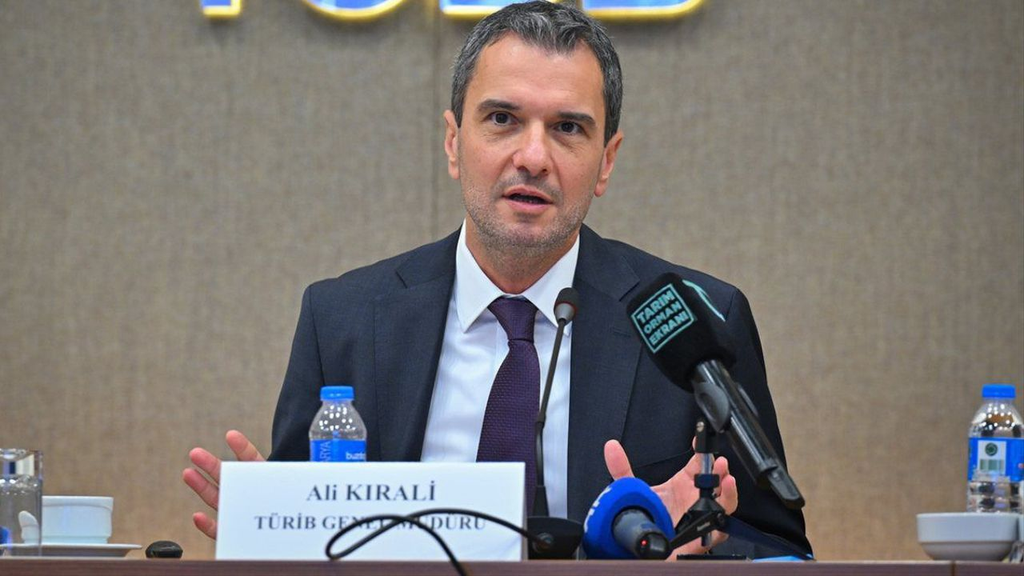
“In the next 2-3 years, this capacity will approach 20 million tonnes. We will make it possible for half of the agricultural trade in the country to be conducted through TÜRİB. Since its inception, our transaction volume in the Electronic Warehouse Receipt (ELÜS) market has reached 475 billion Turkish Lira and our transaction amount has reached 64.5 million tonnes; 1.7 million buying and selling transactions have been made. Wheat has the lion’s share with 57 percent. This share is 32 percent for maize, 8 percent for barley and 1 percent for sunflower seeds. We want to diversify this. New products will also be introduced.”
Two types of contracts to be launched…
Emphasizing that they are currently working on the Futures Market, Kırali noted, “Forward price determination, agricultural insurance and risk management will be important points in the agricultural market. When we open the infrastructure towards the end of this year, we will enable these transactions to take place. We plan to introduce two types of contracts for bread wheat and maize EWR (Electronic Warehouse Receipts) as well as their price indices. EWR-underlying ones will be physically delivered and the index-underlying ones will be cash-settled. Here, all natural and legal persons will be able to trade, just like in our spot market.”
International Commodity Market to be launched…
Underlining that Türkiye is in a key geographical location and that they are undertaking various projects to make the country a trade “hub,” Ali Kırali unveiled that the work to launch the “TÜRİB International Commodity Market” to enable imported agricultural products located in bonded warehouses operating with the permission of the Ministry of Trade to be traded in a more efficient, transparent and easily accessible market structure is in its final stages.
Kırali highlighted that the market participants will be agricultural commodity importers, exporters and legal entities engaged in international commodity trade and shared the following information about the project:
“In addition to our national market, we have completed the software for a new International Commodity Market Project to enable the trading of products in bonded warehouses under the control of the Ministry of Trade in our country’s ports. We will launch this market within 1-2 months. Products in bonded warehouses will be traded in US dollars and euros; these are non-nationalized commodities. Thus, our country will act as a bridge. This will be an important step to further enhance transparency and record-keeping in trade.”
“The Unseen Heroes of Agriculture”
Beginning her speech by emphasizing the invaluable role of women farmers alongside their husbands, Dr. Ayşegül Selışık, Deputy Representative of the UN Food and Agriculture Organization (FAO) in Türkiye, stated, “Women farmers are present in every aspect of agricultural production. They work in the fields, participate in trade alongside their husbands. Women are central to the global agricultural and food system. According to FAO’s most recent assessments, 36 percent of working women worldwide are employed in agricultural and food systems.”
“Essentially 80 percent of global food is produced by small family farms. Whatever we eat, it comes from small family farms, the insurance of agriculture. And those who keep these afloat are women farmers. Despite this, we know that women farmers have limited access to finance and technology. In fact, food insecurity among women is 26.1 percent, while for men it is 24 percent. Even there, men are more fortunate.”
Dr. Selışık also underlined that women farmers constitute 41 percent of the global agricultural and food workforce, yet they still face precarious jobs, poor working conditions and limited rights. “If women owned the same land as men and had access to finance and technology, they would contribute 1 trillion dollars to the global economy. There are institutional and structural obstacles. Meanwhile, across the country, Turkish women farmers make up 45 percent of female employment,” she added.
Işılay Reis Yorgun, a member of the Union of Chambers and Commodity Exchanges of Türkiye (TOBB) Women Entrepreneurs Board, pointed out that women constitute 70 percent of the 2 million family farmers in Türkiye, while the rate of women registered in the Agricultural Registration System (ÇKS) is only 13.3 percent. “Our goal is for our women to have a voice in every stage of production, for their labour to be transformed into economic value, for them to earn their own income and to become a permanent part of a sustainable commercial structure,” she concluded.
Lastly, Hayriyenur Kırman, as a woman farmer and the Black Sea Region’s province of Ordu Representative of the Agriculture and Forestry Youth Council, gave information about the Youth Council’s activities and its project aimed at adding value to hazelnuts through processing…