 THE GLOBAL WINDOW OF TURKISH FOOD AND AGRICULTURE The Global Window of Turkish Food and Agriculture Sector


Related Articles



Press release…
Budapest, Hungary, June 2026: The agri benchmark Cash Crop Conference 2026, hosted by the Institute of Agricultural Economics (AKI), brought together international experts from agriculture, research, industry and policy to discuss the sector’s central challenges: how crop farms can remain competitive while adapting to increasingly volatile markets, rising input-cost risks and more frequent climate-related disruptions.
Two messages stood out: Improved yields did not automatically restore farm margins in 2025 and effective climate adaptation requires more than investments in irrigation.
2025 typical farm results…
The global agri benchmark network analyzes trends in yields, costs, and profitability of arable farming systems across major production regions worldwide using so-called “typical farms”. These farms are defined in collaboration with local experts and are designed to represent the key production systems of their respective regions.
On many European typical farms, wheat, barley and rapeseed yields were above the multi-year average. Typical farms in Canada and Australia also recorded above-average wheat and rapeseed yields. At the same time, results remained variable across regions. Heat and drought continued to affect summer crops, particularly corn and sunflower in southern and south-eastern Europe.
Typical farms in the United States benefited from favorable establishment conditions, with corn and soybean results often exceeding multi-year averages. The majority of typical farms in South America also achieved strong soybean and corn yields, although regional weather conditions again resulted in noticeable differences among farms.
Despite improved yields in several important production regions, profitability across crop rotations declined compared with previous years for many of the analyzed typical farms. Lower crop prices and higher direct and operating costs limited the economic benefit of stronger production.
Land costs followed different trends across regions. While profitability declined for many farms, land costs continued to rise in numerous regions. In South America, more flexible rental arrangements provided partial relief, as land rents often are more closely linked to annual farm profitability.
Climate resilience requires more than irrigation…
Climate adaptation and water management were central themes of the conference. International case studies showed that irrigation can be an important response to drought, but cannot be treated as a stand-alone solution.
Participants highlighted the importance of strengthening water-holding capacity of soils. Conservation practices, no-till systems, adapted crop rotations and a good soil structure can help mitigate the effects of drought and heat, make better use of rainfall and reduce dependence on irrigation. However, the combination of measures always needs to be linked to regional conditions under which farms operate; there is no one-fits-all solution.
The discussions also emphasized that long-term resilience requires a combination of adapted management, strategic investment, diversification and targeted design of risk-management instruments such as insurance and disaster-compensation mechanisms.
From conference discussion to practical farming…
In Hungary, recurrent droughts are increasingly influencing production decisions and encourage farms to reconsider crop rotations, water-management strategies and longer-term investment plans.
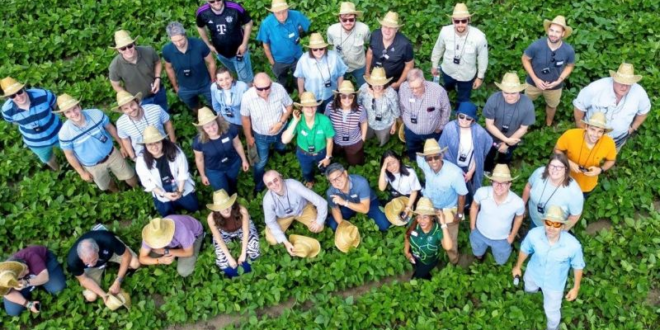
The post-conference farm tour demonstrated how these approaches are already being applied in practice. Participants visited farms in southern and eastern Hungary that combine irrigation, no-till and strip-till practices, adapted crop rotations and precision-farming technologies to respond to water scarcity and changing weather conditions.
The farm visits highlighted a key message of the conference: Successful adaptation does not depend on individual measures, but on production and investment strategies that are tailored to regional conditions.
agri benchmark Cash Crop – A global network for practical agricultural insights…
The agri benchmark Cash Crop network brings together agricultural economists, researchers and farm experts to analyze typical crop farms and production systems worldwide. By combining standardized international farm benchmarking with local expertise, it tracks how the competitiveness of crop-producing regions evolves over time and assesses how changes in practices, technologies and production systems affect farm performance under different conditions.
The network also assesses environmental indicators, including greenhouse gas emissions, alongside economic performance. This helps identify production strategies that can strengthen both farm competitiveness and environmental sustainability.
As market volatility and climate risks increasingly interact, agri benchmark will continue to analyze how crop farms can strengthen their competitiveness, resilience and environmental performance…