 THE GLOBAL WINDOW OF TURKISH FOOD AND AGRICULTURE The Global Window of Turkish Food and Agriculture Sector


Related Articles

October, 2026…
Even as Black Sea uncertainty meets the Ramadan surge…
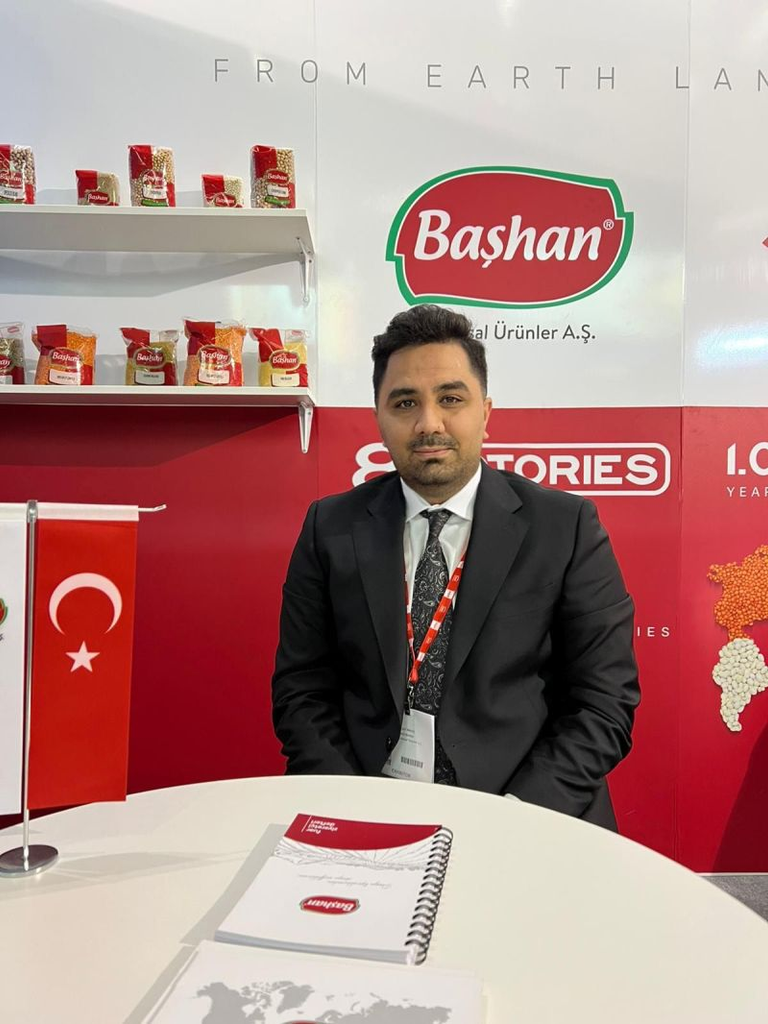
With a solid 2026 crop at home and Ramadan demand approaching, Yusuf Memis of Bashan Agro breaks down a complex scenario of logistical challenges, shifting supply routes — and Türkiye’s growing role in supplying markets across the region.
- Türkiye harvested an average 2026 pulse crop, with very good quality reported across the main commodities.
- Kabuli chickpeas account for the country’s largest exportable surplus, with around 180,000 MT available for overseas markets.
- Ramadan demand is set to intensify in the coming months, putting greater focus on cargo availability, transit times and alternative routes into the region.
The 2026 crop and the policy of self-sufficiency…
Türkiye harvests its pulse crops from May through July. This year, as in the past few years, they harvested an average crop. Weather conditions were good throughout the growing season and Yusuf Memis describes the quality of the crop as “very good”.
The government of Türkiye, notes Memis, is pursuing a policy of self-sufficiency and the volumes produced this year are sufficient to supply the domestic market, with the exception of red lentils, where there is a shortage of 50-100k MT by Memis’ estimation.
In the case of kabuli chickpeas, there is an excess of about 180k MT available for export. Türkiye’s chickpeas are mostly between 7 and 8 mm in size, with some 9 mm chickpeas and very limited amounts of larger calibers.

Türkiye’s 2026 pulse production (Source: Bashan Agro).
Due to restrictions, explains Memis, only those companies that have exported chickpeas in prior years can do so this year. Further, each company’s export volume is capped based on their average export volume over the past five years.
The major market for Türkiye’s chickpea exports is China. Other markets include Jordan, Syria, Iraq and Pakistan.
“Competition for chickpeas is getting very tight,” Memis says and notes that Türkiye’s prices are on the high side at around $600 FOB for 6-7 mm, $780 FOB for 8 mm, and $850-$900 for larger sizes.
The global chickpea trade turned on its head…
“Before the war broke out, the Black Sea countries had taken over the majority of the global trade in small caliber chickpeas. But now the region is in conflict and markets like Türkiye are regaining some of the advantage. Prices are rising every day because the Black Sea region is closed.
When it was open, there was a 180-degree difference. Prices were low because Black Sea production was high. Russia itself produced as many chickpeas as Canada, Argentina and Türkiye combined. But now, because there is no activity from the Black Sea region, there is good demand for chickpeas and the supply is a bit tight.”
The Black Sea region: A huge question mark
“Before the conflict in Ukraine, Türkiye was in a very good position because whatever was shipped through the Bosphorus went by Türkiye, which meant we got the first availability and could manage the trade. But now we are also facing supply chain issues. Alternative origins are very expensive and for that reason here in Türkiye everyone is waiting to see what happens with the Black Sea.
Maybe an agreement will be struck again. Before, when there was a ceasefire, there was a grain corridor secured by Türkiye for both sides to move product through. Without such an arrangement, the supply chain is uncertain.
Further, our alternative origins have been narrowed. As a distribution hub, we used to have multiple origins to choose from, but now it’s limited. And the price difference compared to the Black Sea countries is huge. For example, if you look at Canadian or Australian lentil prices compared to Kazakh and Russian prices, the difference is significant. Therefore, we cannot just turn to Canada again because of the price gap. And the transit time; will it arrive in one month, or three or six? That is why in Türkiye we are taking it slow, being cautious, waiting to see what will happen.
Normally, we re-export 500k MT per year. Half of that was coming from Canada and the other half from the Black Sea countries: Russia, Kazakhstan and Ukraine. Now we don’t know if that second half is coming or not. This is our main concern right now.”

By Dario Bard,
Source: pulsepod.globalpulses.com